Showing lower-emissions flights
Helping travellers find and book more sustainable flights.
Making an informed choice
Skyscanner was the first flight metasearch to show travellers the carbon emissions from flights in its product, so travellers could easily choose a lower emissions flight for their chosen route.
Our role is to share unbiased information with travellers
to help them make an informed choice. Part of this commitment is sharing information on the environmental impact of flights.
Some modern aircraft burn less fuel or emit less CO2e per passenger than others. This depends on factors like the aircraft model and configuration, the distance between origin and destination, and the number of passengers
on board.

Our role is to share unbiased information
with travellers to help them make
an informed choice.
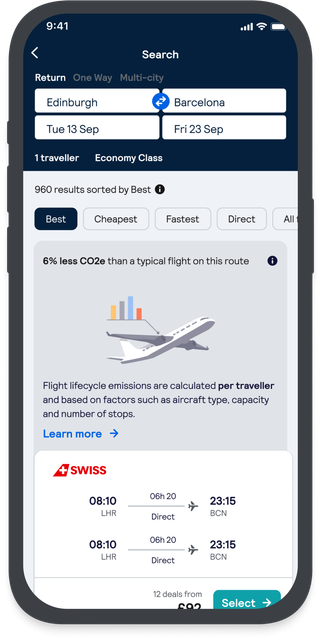
How we highlight flights
We highlight the flights which have lifecycle emissions at least 6% lower than a typical flight on the same route. A ‘typical’ flight represents a median across all dates and available flights for that route.
If there aren’t any lower emissions flights for that search, it’s likely there aren’t any on that chosen day. It’s also possible for many flights on a given day to be less than typical too.
While the lowest emissions flight for a chosen route will likely be direct, in rare cases it’s possible for an indirect option to have lower-than-typical lifecycle emissions if, for example, both flights are on fuel-efficient planes.
Our next arrival: Trains
As travellers look to make more sustainable choices, we’re starting to show train routes in some of our markets – so travellers have the widest range of options available.
Calculating emissions
Our aviation emissions information is powered
by the Travel Impact Model (TIM), which is calculated using data supplied by Travalyst coalition partners.


