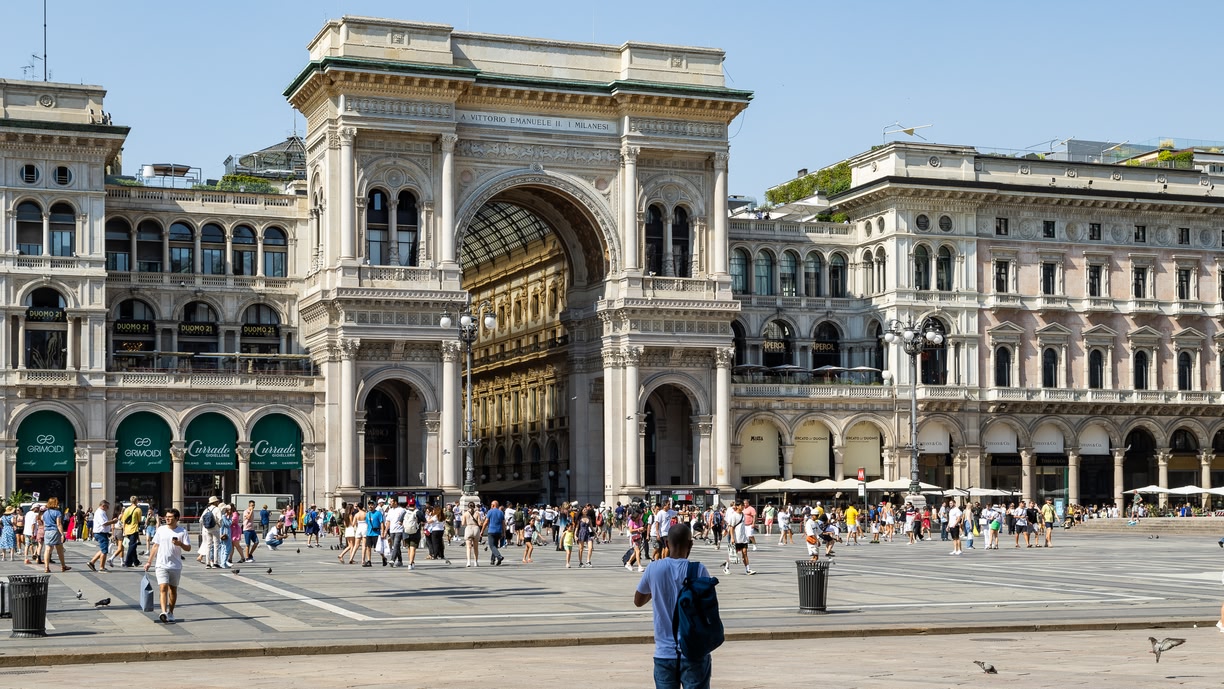

Curious about the weather in Milan, what to see and how to get around? Wonder no more. Here's everything you need to know - and a 48-itinerary to boot - to help you work out whether it could be your next city break escape.
What to know about Milan city breaks
What's the weather in Milan?
We all know how important having good weather is when you're on holiday. Luckily, Milan is blessed with a spectrum of seasonal weather, from hot summers to cold, foggy winters, it's got it all.
Generally, visiting in April and May or September and October is considered the best option when booking a Milan city break, as the weather is temperate without being too hot (as in August, when most of the locals escape to cooler climes).
Let's take a look at the average monthly weather in Milan by month, so you can choose the time of travel which suits you best.
Month | Average air temperature (°C) |
|---|---|
January | 0-7 |
February | 2-10 |
March | 5-15 |
April | 8-18 |
May | 12-22 |
June | 16-26 |
July | 18-29 |
August | 18-29 |
September | 15-25 |
October | 11-19 |
November | 6-13 |
December | 1-8 |
Of course, you can always use Skyscanner's Whole Month search tool to see when the cheapest flights in any given month are, which should help you narrow down potential travel dates for your Milan city breaks.
What's the best way to get around Milan?
Even if Milan is featuring as part of a bigger tour around Italy - perhaps a road trip even (check out our guide to hiring a car in Italy here) - we don't advise driving into Milan itself. As with most big cities, congestion is high and parking difficult to find (and usually pricey when you do).
Milan's public transport system, ATM, is comprehensive and efficient, offering visitors a range of ways to easily get around the city, and for a reasonable price too. The are buses and trams, as well as a metro, connecting most corners of the city.
You'll need to buy a RicaricaMi card (paper tickets are no longer issued), which can be loaded with money and then used across the public transport system. Fares begin at €2 for a single journey, but we advise buying a 24- or 48-hour travelcard to save money on your trips over multiple days (there are also weekly, monthly and annual travel cards available if you're staying longer).
If you're staying centrally, you'll be able to access plenty of the city's highlights by foot, as Milan is an eminently walkable city.
Where should I stay in Milan?
Milan is a mélange of hip, classy coffee houses, fashion forward avenues and late-night urban outlets. You'll be hard pushed to find a region not perfectly suited to your tastes, but when considering where to stay for your Milan city break, consider your budget, your interests (are you visiting for museums, gastronomy, shopping or something else?) and how long you're willing to spend on transport navigating the metropolis.
Below is an overview of some of the city's main neighbourhoods, which provide a great starting point for working out where you might want to bed down:

Quadrilatero della Moda
Good for: shopoholics and fashionistas
Shopping in Milan is a right of passage for any first-time visitor, so to see the city's offerings in all their glory, head to Quadrilatero della Moda, the primary shopping district and home to every major fashion house. Armani, Alexander McQueen, Berluti, Gucci and Stella McCartney are just the tip of the high-fashion iceberg. If the price tags put you off, don't worry, window shopping is more than entertaining enough, particularly in an area so meticulously maintained.

Duomo
Good for: access to the city's best attractions
Ideal for first-time visitors, this is the most central neighbourhood of Milan, and provides easy walking access to all the major sites including the Duomo, Galleria Vittorio Emanuele II and La Scala. You're also in a great spot for connectivity, and will find it easy to travel to and from some of the city's outer limits. It comes at a price though, with Duomo costing more per night on average than other areas of Milan.

Brera
Good for: boutique shops and coffee spots
Sometimes referred to as the 'Montmartre of Milan', Brera is the arts district of the city oozing bohemian vibes and artsy expression. Creative-types will love staying here for Milan city breaks, where cobblestone streets are flanked by stylish cafes and the Sforza Castle and Brera Art Gallery are within easy reach.

Navigli
Good for: nightlife, bars and restaurants
Wondering what to do in Milan? Head to Navigli. Centred around Milan's canal system, this neighbourhood was designed by Leonardo Da Vinci and is the nightlife hub of the capital. Buzzy bars, unforgettable restaurants and eclectic night clubs operate late into the night. It's also the perfect place to try out the city's aperitivo scene.
What should I do in Milan?
What shouldn't you do in Milan? Italy's capital is replete with cultural riches, from jaw-dropping architecture to historic fashion houses and tantalising cuisine, it can be hard to know where to start.
That's why we've put together our 48-hour itinerary of what to do in Milan, so you don't have do!
Day 1 - Morning
Tuck into breakfast at three-storey Italian food temple Peck. First opened in 1883, this gourmet heaven sells everything you need for a morning picnic. You’ll find ripe seasonal fruits, vintage cheeses and cream-filled pastries. Choose some nibbles and take them to Sempione Park to devour on the tree-lined lawns. Or, find a bench near the artificial lake, where flocks of birds gather to bathe.
After you’ve fuelled up, head to the park’s Castello Sforzesco – a 15th-century citadel which is now home to seven museums. From ancient art to musical instruments, it covers a wide range of Milan’s history and culture. The Ospedale Spagnolo (Spanish hospital) section is home to Michelangelo’s final work, the Rondanini Pieta.
Day 1 - Afternoon
For a wallet-friendly lunch on the go, it’s hard to beat a piadina. These grilled-flatbread sandwiches are filled with fresh, Italian ingredients like creamy mozzarella, melt-in-the-mouth prosciutto and juicy roast vegetables. There are lots of places to grab one, but Piadineria Artigianale Pascol is renowned for its fresh, generous fillings. Try the Stelvio (speck, fontal and sautéed porcini mushrooms) or the Fumagalli (aubergines, courgettes, mozzarella, dried tomatoes).
Head directly to the iconic Duomo di Milano (Milan Cathedral) – a must-visit during any Milan city break. This impressive church took 600 years to build and is full of Renaissance paintings, thousands of statues and even a nail believed to be a relic from the crucifixion. Time your visit for the sunset and enjoy incredible golden-hour views from the cathedral’s roof terrace (or head there early in the morning to avoid the crowds). On clear evenings you can see all the way to the Alps. Book tickets in advance to skip the queue.
As night falls, hop over to the vibrant Navigli district for Aperitivo – the Italian ‘happy hour’ tradition of free snacks to accompany sundown cocktails. Each bar has its own approach, with some (like MAG Café) serving cheese and charcuterie platters while others (such as Carlo e Camilla in Segheria) serve more substantial, tapas-style dishes.
Bring loose euro change (and tissues) to use the public bathrooms in Milan, as they can charge around 50 cents for use.
Day 2 - Morning
Head out of the centre and grab a coffee at photogenic Bar Luce. The 50s-inspired interiors look like something out of a Wes Anderson film – mainly because they were designed by the quirky American filmmaker himself.
The café sits in the lobby of Fondazione Prada, a contemporary art gallery based in a former gin distillery and run by the world-renowned Prada fashion family. Design fans will find the vast museum well worth the €15 entry price, with several permanent and temporary conceptual art exhibits spread across the post-industrial buildings. If you’re not keen on going inside, it’s still worth wandering around the courtyard (for free) and soaking in the atmosphere.
Day 2 - Afternoon
Back in the city centre, take in one of Milan’s most macabre attractions, Santuario di San Bernardino alle Ossa. This 13th-century church is known for its ossuary, where human skulls and bones were excavated from a nearby graveyard when it ran out of space in 1210, and rearranged in a baroque wall design in the 18th century.
No Milan city break would be complete without some designer window shopping. Ooh and aah at the windows of innovative concept store, 10 Corso Como. Tucked into a courtyard to the north of the centre, it’s filled with curated pieces from some of the world’s top labels. (If you can’t leave without some new threads, snap up a bargain at the store’s hidden outlet on 3 Via Tazzoli).
Stay on at 10 Corso Como to explore its design-led book shop, stylish cocktail bar and (free) art gallery. In the past, this has hosted exhibitions by famous fashion photographers like Annie Leibowitz, Bruce Weber and David Bailey. The roof terrace is the perfect place to catch your final Milanese sunset.
Now you have an idea of what to see, where to stay and when you want to take your Milan city break, why not get booking?
Milan city breaks FAQs
Looking for cheap flights? Skyscanner helps you find the best flights, hotels and car rental deals for your next trip.


